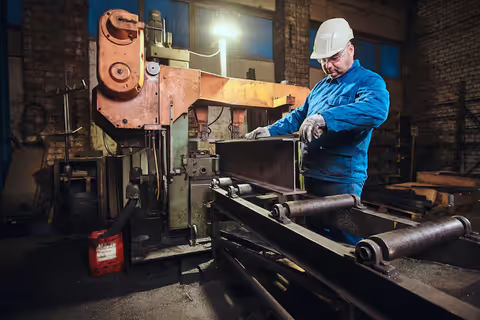
Plastic Transfer Molding Machines: An Overview of Systems and Operating Methods
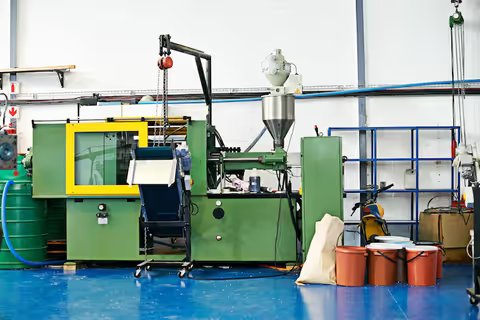
A Plastic Transfer Molding Machine is industrial equipment used to form plastic and polymer-based materials into specific shapes by transferring a measured amount of molding material into a heated mold cavity under controlled pressure.
The process is related to compression molding but uses a separate chamber, commonly called a transfer pot, to prepare and move the material into the mold. Plastic transfer molding is used for components that require controlled dimensions, enclosed shapes, inserts, or detailed features. The method is particularly relevant to thermosetting plastics and selected composite materials.
Context
What Is a Plastic Transfer Molding Machine?
A Plastic Transfer Molding Machine contains a molding unit that prepares material in a transfer chamber before pushing it into a closed mold. The material is heated or conditioned until it reaches a suitable state, after which a plunger applies pressure and moves it through channels called runners and gates.
Inside the mold cavity, heat and pressure help the material take the shape of the cavity. Depending on the material, curing or solidification occurs within the mold before the finished component is removed.
Origins of Transfer Molding
Transfer molding developed from compression molding as manufacturers sought greater control over how molding compounds entered enclosed cavities. Instead of placing the entire material charge directly inside an open mold, transfer molding uses a separate chamber and controlled material movement.
This arrangement became useful for producing components with inserts, complex geometries, and multiple cavities. Over time, hydraulic controls, temperature regulation, programmable systems, and automated material handling have been incorporated into machine designs.
How the Process Works
A typical Plastic Transfer Molding Machine follows several stages:
- Material preparation: A measured quantity of molding compound is prepared according to the material specification.
- Loading: The material is placed into the transfer chamber.
- Mold closing: The mold halves are brought together and held under pressure.
- Heating or conditioning: The molding material reaches the required processing condition.
- Transfer: A plunger pushes the material from the transfer chamber through runners and gates.
- Curing or solidification: Heat and pressure allow the material to form and stabilize inside the cavity.
- Mold opening: The mold separates after the required cycle.
- Part removal: Ejector mechanisms or controlled manual procedures remove the molded component.
The exact sequence varies according to the material, mold design, machine configuration, and component geometry.
Main Components
A Plastic Transfer Molding Machine commonly includes a hydraulic or electric drive system, mold-clamping mechanism, transfer pot, plunger, heating system, control panel, mold assembly, runners, gates, and ejector mechanism.
Temperature sensors monitor heating zones, while pressure and position sensors may provide information about the molding cycle. Modern systems can use programmable controllers to coordinate several operations.
Materials Used
Transfer molding is particularly associated with thermosetting materials. Examples include phenolic molding compounds, epoxy-based compounds, silicone materials, and certain other polymer systems.
The material behaves differently from a thermoplastic during processing. Thermosetting compounds undergo a chemical curing reaction and generally cannot be repeatedly melted and reshaped after full curing.
Importance
Role in Plastic Manufacturing
Plastic transfer molding provides a controlled way to produce components with enclosed or intricate cavities. Because the material enters the mold through a transfer system, inserts and internal features can often be incorporated into the molding process.
The method is used in electrical components, electronic assemblies, automotive parts, industrial components, appliance elements, and selected specialized polymer products.
Components With Inserts
One important application involves molding around pre-positioned inserts. An insert may be a metal, ceramic, or another component placed inside the mold before material transfer.
When the molding compound enters the cavity, it surrounds the insert and forms a combined component. This approach can reduce the need for separate assembly operations in some product designs.
Control of Material Flow
Material flow is a central consideration in transfer molding. The compound must move through the transfer pot, runners, gates, and mold cavity while maintaining appropriate temperature and pressure conditions.
Mold designers examine flow paths, cavity geometry, vent locations, and gate positions. Poorly designed flow paths can contribute to incomplete filling, trapped air, weld lines, or uneven curing.
Quality Factors
The final molded component can be affected by several variables:
- Material composition and moisture
- Mold temperature
- Transfer pressure
- Transfer speed
- Cure time
- Mold geometry
- Runner and gate design
- Venting
- Insert positioning
- Mold surface condition
- Ejection method
Consistent process control helps reduce variation between production cycles.
Typical Applications
| Industry | Component Examples | Relevant Process Feature |
|---|---|---|
| Electrical | Insulating components | Controlled encapsulation |
| Electronics | Protective molded parts | Detailed cavity filling |
| Automotive | Selected under-hood components | Heat-resistant materials |
| Appliances | Structural and insulating parts | Molded geometry |
| Industrial equipment | Polymer components | Insert molding |
| Composite manufacturing | Reinforced components | Controlled material transfer |
Transfer Molding Compared With Other Methods
Transfer molding sits between several established polymer-forming methods in terms of process arrangement. Compression molding places material directly into the mold before pressure is applied, while injection molding typically melts or conditions material in a barrel and injects it through a nozzle.
Transfer molding uses a separate transfer chamber and plunger. This gives the process a distinct material-flow arrangement that can be useful for certain thermosetting compounds and components containing inserts.
Recent Updates
Greater Process Automation
Recent Plastic Transfer Molding Machine development has increasingly focused on automated control of temperature, pressure, transfer movement, mold closing, and ejection. Programmable controllers can coordinate these operations according to defined process parameters.
Automated monitoring can also record cycle information. This creates process records that can be reviewed when investigating variations in molding conditions.
Digital Process Monitoring
Sensors can monitor pressure, temperature, position, cycle duration, and other machine variables. Data can be displayed through digital control interfaces and, in some production environments, transferred to manufacturing information systems.
Digital monitoring can help operators identify changes in machine behavior and compare actual conditions with defined process parameters.
Improved Mold Design
Computer-aided engineering and mold-flow analysis are increasingly used during component development. Simulation can examine how material may move through runners, gates, and cavities before physical production begins.
Engineers can use these models to examine potential air entrapment, filling behavior, temperature distribution, and pressure requirements. Actual molding behavior still depends on material characteristics and machine conditions.
Energy Management
Heating systems and hydraulic drives are important sources of energy use in molding equipment. Current machine development includes attention to improved temperature regulation, electric drive systems, hydraulic efficiency, and automated shutdown or standby functions.
Actual energy consumption depends on machine size, material, cycle time, mold temperature, production conditions, and equipment architecture.
Advanced Materials and Composites
Transfer molding is also relevant to composite manufacturing, where polymer matrices can be combined with reinforcing materials. Developments in polymer formulations, fillers, fibers, and curing systems continue to expand the range of material characteristics that can be processed.
Material selection requires attention to curing behavior, viscosity, thermal characteristics, reinforcement distribution, and compatibility with the mold and machine.
Connected Manufacturing
Some modern molding systems can connect with factory networks and production-monitoring platforms. Information such as cycle parameters, equipment status, alarms, and production records can be collected digitally.
As industrial equipment becomes more connected, cybersecurity, user access control, data integrity, and network segmentation become relevant considerations.
Laws or Policies
Manufacturing Requirements in India
A Plastic Transfer Molding Machine used in India can be affected by regulations concerning workplace safety, environmental protection, electrical equipment, plastics, and industrial operations. The exact requirements depend on the facility, materials, processes, and final products.
The Occupational Safety, Health and Working Conditions Code, 2020 forms part of India's broader workplace safety framework. Applicable requirements can include machine guarding, safe operating procedures, worker protection, equipment maintenance, and workplace conditions.
Environmental Regulations
Plastic-processing facilities may need to consider environmental requirements related to waste, emissions, wastewater, and material handling. The Environment (Protection) Act, 1986 provides a broad legal framework for environmental protection.
The Central Pollution Control Board and relevant State Pollution Control Boards administer or support various environmental requirements. The specific obligations depend on the industrial activity and location.
Plastic Waste Management
Where a manufacturing operation generates plastic waste or produces regulated plastic packaging, the Plastic Waste Management Rules, 2016 and subsequent amendments may become relevant.
Not every molded plastic component falls under identical requirements. Applicability depends on the material, product category, packaging relationship, waste stream, and other regulatory factors.
Electrical and Technical Standards
Molding equipment contains electrical controls, motors, heating systems, sensors, and sometimes hydraulic systems. Applicable BIS and IEC standards may therefore be relevant to equipment design, electrical safety, control systems, and electromagnetic compatibility.
The specific standards should be identified according to the machine architecture and intended industrial environment.
Tools and Resources
Mold-Flow Analysis
Mold-flow simulation software can model material movement through runners, gates, and cavities. These tools can help engineers examine filling patterns, pressure requirements, temperature changes, and potential air-entrapment areas.
Measurement Equipment
Quality-control activities may use dimensional measurement instruments such as calipers, micrometers, gauges, and coordinate-measuring systems. Temperature and pressure instruments can also be used to verify process conditions.
Process Documentation
Useful production records can include:
- Material batch identification
- Mold identification
- Temperature settings
- Transfer pressure
- Transfer time
- Cure time
- Cycle duration
- Inspection measurements
- Equipment maintenance records
- Process deviation records
These records help establish a relationship between molding conditions and finished-component characteristics.
Technical Resources
Useful references include Bureau of Indian Standards publications, CPCB guidance, ISO documents, material technical data sheets, mold-design references, machine manuals, and polymer-processing textbooks.
Manufacturers and engineers may also use CAD software, finite-element analysis tools, statistical process-control software, and digital production-monitoring platforms when developing or evaluating transfer-molding operations.
FAQs
What is a Plastic Transfer Molding Machine?
A Plastic Transfer Molding Machine forms polymer components by placing molding material into a transfer chamber and pushing it into a closed heated mold under controlled pressure. The material then cures or solidifies within the mold.
How does a Plastic Transfer Molding Machine work?
The machine places a measured material charge into a transfer pot. A plunger moves the material through runners and gates into the mold cavity, where heat and pressure support the required curing or forming process.
What materials are used in Plastic Transfer Molding?
Transfer molding is commonly associated with thermosetting compounds such as phenolic, epoxy-based, and silicone materials. Certain composite materials can also be processed through transfer-molding techniques.
What is the difference between transfer molding and injection molding?
Transfer molding uses a separate transfer chamber and plunger to move material into a closed mold. Injection molding generally uses a barrel and screw system to condition and inject material directly into the mold.
What are the main applications of a Plastic Transfer Molding Machine?
Applications include electrical insulation components, electronic parts, selected automotive components, appliance elements, industrial parts, and composite products. The suitable application depends on the material and mold design.
Conclusion
A Plastic Transfer Molding Machine uses controlled pressure, heat, and mold geometry to form polymer materials into defined components. The process is particularly associated with thermosetting compounds and can accommodate components containing inserts or detailed cavity features. Current developments include automated controls, digital monitoring, mold-flow simulation, energy management, advanced materials, and connected production systems. In India, applicable workplace, environmental, plastic-waste, electrical, and technical requirements depend on the specific manufacturing operation and product.

Related Post...
Plastic Transfer Molding Machines: An Overview of Systems and Operating Methods
Updated: September 17, 2026
Read More